
High Protein Low Calorie Vegan Recipes for Fat Loss (The Busy Woman Guide)
What This Post Is About
This is your friendly guide to eating high protein low calorie vegan recipes that help you stay satisfied, lose fat, and build the body you always dreamed of. I’ll show you why this approach works so well, how to build your plates, and I’ll give you a full library of recipes you can start using today.
And whenever you want a quick help planning your meals, PowerPlant Boss can build a personalized menu for you instantly.
High Protein Low Calorie Vegan Recipes for Fat Loss
If you’ve ever tried to eat healthy, cut calories, or lose fat on a vegan diet, you’ve probably noticed something: most plant-based recipes online are super delicious… but also super carby, sometimes high in fats, and definitely not high enough in protein to keep you full for long.
I lived that reality for years.
As a busy mom, a full-time employee, a wife, and someone building her dream body at the gym, I quickly realized that simply “eating healthy” wasn’t enough.
I was eating plant-based. I was eating clean. But I didn't have the body that I wanted.
When I started lifting and following structured workouts, I understood something important:
to make this work, I needed more protein and less fat in my diet.
Not even crazy amounts of protein… just enough to support my muscles, curb my hunger, lose weight, and balance my nutrition.
But finding tasty and fast-to-cook high-protein and low-calorie vegan recipes that I actually WANTED to eat was honestly a struggle.
So I learned.
I experimented.
I tested ingredients, macros, recipes, and meal prep strategies.
And I started creating yummy meals that helped me feel full, energized, and supported in my fitness journey.
That’s when this blog was born.
My mission is to help busy plant-based women eat in a way that supports their fitness goals… not with restrictive dieting, but with simple high protein low calorie vegan meals you actually enjoy eating.
This guide is your roadmap to everything on my blog.
A place you can always come back to for recipes, ideas, structure, and inspiration.
I’ll keep updating this post every time I publish a new recipe, so feel free to save it, pin it, or add it to your favorites.
And if you want to know more about me or my full story, you can read it here:
Meet Malika
Now let’s get into your guide, my friend.
How Much Protein Do You Really Need? (Without Overdoing It)
I already wrote a full deep dive on this here:
Protein for Weight Loss Vegan: How much you really need?
Let me give you the short version for this guide.
What science actually says
Big research reviews (called meta-analyses) show that results for strength and muscle gain level off around 1.6 grams of protein per kilogram of body weight per day, which is about 0.7 grams per pound. Going far beyond that does not give much extra benefit for muscle. British Journal of Sports Medicine+2PMC+2
Other newer reviews suggest that somewhere around 1.5–1.6 g/kg per day is a very safe, effective “sweet spot” for people who train regularly. SpringerOpen+1
Fitness educators like Jeremy Ethier from Built With Science break this down in a simple way: for most lifters, somewhere between 0.55 and 0.9 g of protein per pound of body weight is enough to get almost all the benefits. Built with Science+2Built with Science+2
So in plain language:
- More protein is not always better.
- There is a useful range, not a magic number.
The plant-based angle: why vegans often aim a bit higher
Plant protein is amazing, but it is a bit less efficiently absorbed than animal protein. Research and expert reviews suggest that the body might use around 70–80 % of amino acids from plant protein compared to 85–90 % from animal protein, depending on the food and processing. The Washington Post
That is why many vegan coaches recommend being on the upper side of the normal protein range. It is not about fear. It is just a smart buffer so your body gets what it needs.
In my full protein post, I shared the perspectives of:
- Dr. Fuhrman, who focuses on nutrient density and whole plant foods.
- Leif Arnesen (Vegan Superhero Academy) and Nimai Delgado, who recommend slightly higher protein when you are training for strength and fat loss.
The message is consistent:
Think of protein as a minimum you want to hit, not a strict upper limit.
So what does that mean for you in numbers?
If you are an active vegan woman working on fat loss and muscle tone, a very realistic range is:
- 0.7–1.0 g of protein per pound of body weight
(about 1.6–2.2 g per kg)
For example, I weigh around 129 lb.
- My personal target is around 105 g of protein per day.
- That lands in the middle of the recommended range.
- It fits my calorie target of 1,300–1,500 kcal, and it keeps me full and strong in the gym.
You do not need to copy my number exactly. The range matters more than the perfect number.
How much per meal?
Most research suggests that 20–30 g of protein per meal is plenty for muscle repair and growth. Going higher in a single meal is not harmful; it just does not create more muscle on its own. Check this article, Taylor & Francis Online+1, and Jeremy Ethier video.
If you eat 3 main meals a day, aiming for 25–30 g in each is a very good starting point.
Want your exact number without doing math?
If all of this feels like too many numbers, that is exactly why I created PowerPlant Boss.
You tell it:
- your age and weight
- your activity level
- your goal (fat loss, muscle gain, maintenance)
And it calculates your protein target and full macros for you, then builds a vegan meal plan that fits your life.
You can think of this pillar post as the “theory,” and PowerPlant Boss as the “do it for me” button.
How To Eat Big Plates, Feel Full, And Still Lose Fat
Knowing your protein target is step one.
Step two is understanding calorie density and how to build plates that keep you full.
This is where the magic happens.
I wrote a full post on this here:
How to Stay Full on a Vegan Diet While Cutting Calories
Here is the summary.
Calorie density in real life
Influencers like Plantiful Kiki and Chelsea Mae talk a lot about this.
- Kiki lost around 70 pounds using The Starch Solution style of eating and focuses heavily on calorie density and plate building.
- Chelsea Mae shares how she lost about 40 pounds by increasing the volume of low calorie foods (especially vegetables and starches) while keeping higher calorie foods in check.
The core idea from them and from books like The Starch Solution is simple:
You keep eating large portions, but you lower the calories per bite by focusing on foods that are naturally low in calorie density like vegetables, fruits, whole grains, and legumes.
You get the same full plate, just with less energy packed into it.
My version of the fat loss plate
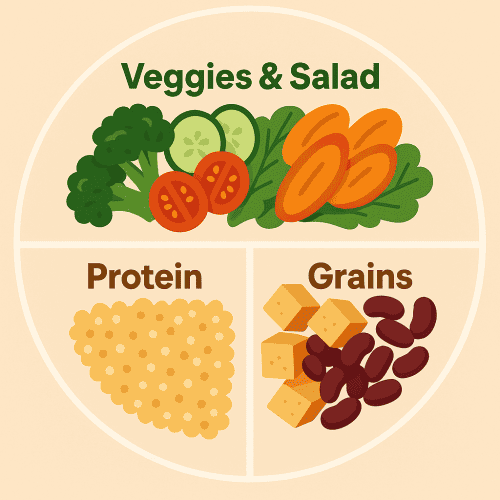
Here is how I apply those principles in my own life. This is the plate structure I aim for most days:
- Half of the plate:
Non starchy vegetables and salads.
Think leafy greens, cucumbers, zucchini, carrots, peppers, tomatoes, broccoli, cauliflower, etc. - About one third of the plate:
Protein rich foods.
Tofu, lentils, chickpeas, beans, high protein pasta, or a mix of them. - The final third of the plate:
Smart carbs.
Things like potatoes, sweet potatoes, quinoa, brown rice or gluten free grains.
This way:
- I get a huge volume of food for relatively low calories.
- I still hit your protein target.
- I get enough carbs to support my workouts and energy.
On most days, this structure helps me naturally get close to 800 g of fruits and vegetables without feeling like I am dieting.
If I notice my hunger is high or my calories are creeping up, I do not eat less food.
I swap higher calorie ingredients for lower density ones. For example:
- I add a big lettuce salad to every lunch sometimes dinner too,
- I maximum my snacks on whole satisfying fruits like mango, papaya, grapefruit...
Visualizing the plate
You can imagine your plate like a simple graphic:
- Half the circle in green (veggies and salad)
- One slice in a protein color (tofu, beans, lentils)
- One slice in a grain color (potatoes, quinoa, rice or pasta)
Your Recipe Library (Living Index)
This section is your home base for recipes.
Every time I publish a new recipe that fits this world of high protein, low calorie vegan eating for fat loss, it will be plugged into one of these categories.
Some of the recipes below might not be live on the blog yet. They are part of my “coming soon” list, but I am including them here so you can see what is coming and bookmark this page.
I recommend:
- saving this post in your browser,
- pinning it to Pinterest,
- and coming back regularly to see what is new.
Later, you will be able to click directly from here to each recipe.
Breakfast
High protein breakfasts that keep you full and set up your day:
- Chickpea omelette
- Mung dal omelette
- Southwest tofu scramble
- Easy Chocolate Oatmeal with protein powder
- Overnight oatmeal with protein powder
- Decadent tiramisu overnight oats (vegan)
- High protein green smoothie
- Breakfast burrito
- Pancakes IHOP style – fluffy protein pancakes
Many of these are perfect for meal prep. Overnight oats, scrambles, and omelettes can be prepped or partially prepped in advance.
Lunch & Bowls
These work beautifully for lunch or dinner, but I know many of you love bowls at midday:
- Burrito bowl (Mexican style think Cafe Rio / Costa Vida style)
- Teriyaki Tofu Rice Bowl (Chipotle style with an asian twist)
- Mushroom Meatloaf Vegan (not only for the holidays!)
- Mediterranean bowl (Aubergine Kitchen inspired)
- Mediterranean quinoa chickpea salad
- Warm potato, bean and corn salad
- Red curry chickpea spinach bowl
- Baked teriyaki tofu and broccoli
- Cauliflower fried rice with tofu
- Jackfruit BBQ Bánh Mì sandwich
- Black bean and veggie quesadillas
- Family bean curd Chinese style
- No butter “no chicken” with naan
You can build almost all of these using the plate method: half veggies, one third protein, one third smart carbs.
Dinner Mains
Comfort style dinners that still support your goals:
- Pizza style MOD pizza (high protein toppings and lighter base)
- Burger and fries (high protein patty with baked fries)
- Pad Khing Thai
- Thai curry
- Best tofu “chicken”
- Vegan Alfredo pasta (with high protein sauce)
- Bolognese or spaghetti pasta sauce
- Lentil Bolognese
- Butternut squash with chickpeas
- Gluten free lentil loaf + gravy
- Stuffed acorn squash (quinoa and lentils)
- High protein shepherd’s pie
You can make many of these meal prep dinners by baking in large trays or casseroles and reheating portions through the week.
Soups & Stews
Cozy, nourishing, and easier to keep low calorie while high in protein:
- Mung dal and lentil curry soup
- Pumpkin bean chili
- Minestrone soup
- Creamy potato leek soup with tofu
- Chicken tortilla soup (vegan)
- Zuppa Toscana soup
- Pho (vegan, with high protein toppings)
Soups are a great way to add more vegetables, beans, and volume to your day with fewer calories.
Salads & Sides
Fresh, crunchy, and perfect for bulking up your plate:
- Italian dressing salad
- Mediterranean quinoa chickpea salad
- Warm potato, bean and corn salad
- Low-calorie mashed potatoes
- Vegan Gluten-free Gravy
- Vegan bacon (to top salads or bowls)
- Fried pitas for dipping
- Cauliflower fried rice with tofu (also a main)
You can mix and match these with any of the mains above to create full plates.
Snacks, Dips & Treats
Because snacks and treats can still fit in a fat loss phase:
- White bean and herb dip (hummus alternative)
- Peanut butter cookies (higher protein version)
- Protein gingerbread cookies
- Black bean brownies
- High protein, lower fat vegan ice cream
- Popcorn (light, high volume snack)
And here is my helpful post on the 5 Best Vegan Sugars for Weight Loss.
I like to keep snacks either fruit plus a bit of protein (like a smoothie) or high volume, lower calorie choices like popcorn or veggie sticks with white bean dip.
A Sample Day That Puts It All Together
Here is an example day that:
- hits around 100 g of protein,
- stays in a fat loss range for calories,
- and follows the half plate veggies, one third protein, one third carb method.
Breakfast
Decadent tiramisu overnight oats with protein powder
- Around 25 g protein
Lunch
Burrito bowl with baked teriyaki tofu, black beans, lots of lettuce, salsa, and a small portion of rice or quinoa
- Around 30 g protein
Snack
High protein green smoothie or white bean and herb dip with veggies
- Around 15–20 g protein
Dinner
High protein shepherd’s pie or lentil Bolognese over a bed of zucchini noodles plus a side salad
- Around 25–30 g protein
This structure usually lands somewhere around 1,300–1,500 calories for me, with lots of fiber, volume, and satisfaction. Your numbers can be adjusted based on your body and goals.
If you do not want to think about how to put all of this together, PowerPlant Boss can generate a full 7 day plan based on the exact recipes you like.
How This Blog And PowerPlant Boss Work Together
Here is how I see it:
- This blog is where I share my journey, what I learned, and the recipes that make vegan eating for weight loss feel joyful and realistic.
- PowerPlant Boss is your smart helper that:
- calculates your macros,
- suggests recipes,
- builds meal plans from what is on the blog,
- and adapts to your lifestyle.
You do not need to be perfect or track forever.
You just need the right direction, supportive tools, and meals you actually look forward to.
⭐ If you try one of these recipes or have a question about your own journey, leave me a comment below. I answer every single one.
And when you’re ready for more inspiration, explore the recipe sections on the blog: breakfast, bowls, dinners, soups… everything you need to make this journey simple and yummy.
Frequently Asked Questions
1. Do I really need “high protein” as a vegan to lose fat?
You do not need extremes, but getting enough protein helps protect your muscle, keeps you fuller longer, and makes fat loss more comfortable. Most active women do well around 0.7–1.0 g per pound of body weight.
2. Why focus on low calorie meals if I am already eating healthy?
Because “healthy” can still be very calorie dense. By focusing on low calorie density, you can eat big, satisfying plates and still stay in a calorie range that supports fat loss.
3. Can I hit my protein goal without protein powder?
Yes. Foods like tofu, lentils, chickpeas, and beans can absolutely get you there. Protein powder is just a tool for convenience on busy days.
4. Is it safe to eat 100 g of protein a day on a vegan diet?
For healthy adults, research supports protein intakes up to at least 1.6–2.0 g/kg per day as safe when calories are appropriate and hydration is good.
5. How do I start if I feel overwhelmed?
Start simple:
Use PowerPlant Boss if you want help filling the gaps or calculating your numbers.
Pick one breakfast, one lunch bowl, and one dinner from the recipe ideas above.
Repeat them during the week.


Comments
No Comments